The documented route: keep one ordinary Marketplace → Stall chain working, use Ghost Paint on both Marketplaces so each one’s effect accepts Commercial instead of Stall, then place the two markets so each legally sits in the other’s target relationship. Painting only A is not enough — an unpainted B still accepts Stall, and a Commercial Marketplace is not a Stall. With both effects retargeted and the two markets legally connected, their own timers start the exchange. It is a bounded engine — trigger caps and placement rules still apply — not an infinite loop, and not achievable on every map.
Keep one ordinary market chain working first
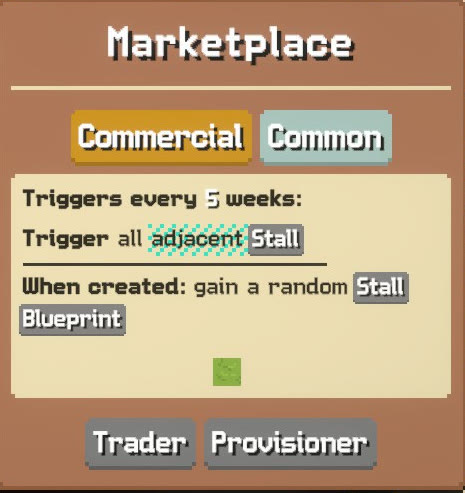
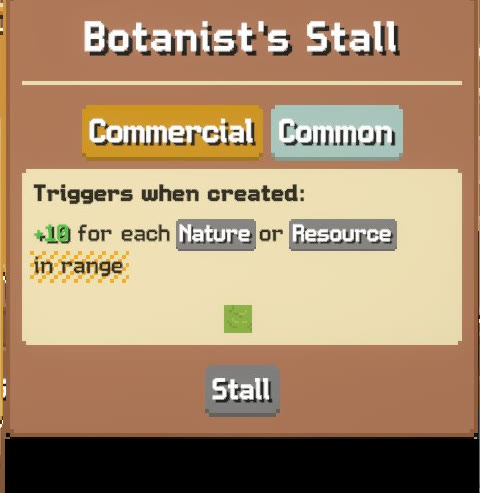
The base engine is the pictured pair: a Marketplace triggers all adjacent Stalls on its timer and hands you a random Stall Blueprint when created. That chain is your fallback and your control group — it proves the market rhythm works before any paint is involved. If you cannot yet assemble Ghost Paint and a second Marketplace, this ordinary chain is what you keep running, per the paint guide’s own advice to keep working engines unpainted until the upgrade is real.
Ghost the target category, not the building
Ghost Paint rewrites the accepted category inside an effect — and the Marketplace is the paint guide’s own worked example, changing its accepted category from Stall to Commercial. The Marketplace building keeps its own Commercial tag throughout; what changes is which targets its trigger accepts. A Marketplace is a valid Ghost target precisely because its effect contains a category to rewrite — the condition from the paint rules. The engine needs this on both markets: painting A lets A target B, but an unpainted B still accepts Stall — and a Commercial Marketplace is not a Stall — so B needs the same repaint before it can target A back. Confirm the category you want is actually present on your map before spending the paint.
Retarget logic · one word changed
Make two Markets legally adjacent
The hard part is placement, not paint. Two copies of the same building fight the same-building range-overlap placement restriction — and the range-restriction thread’s accepted answer is that a Plaza lifts exactly that restriction, which is how players legally cluster copies of one building. Moving or copying pieces are the other documented legal means. What does not work: forcing terrain rules (a Plaza does not lift those) or assuming the markets tolerate any gap — the acceptance relationship must actually cover the other market, so verify with the live placement preview before celebrating.
Known failure branches, kept open
- The Luxury/Balloon/Silk reports: several players report this family of combinations failing after painting — with guesses but no confirmed cause and no official fix through Oct 4. This page does not call it a bug or a feature; if your route involves those pieces, treat the outcome as unverified and keep the unpainted fallback.
- Caps are real: the paint guide says most — not all — buildings have a weekly trigger cap. “Two markets forever” is not the claim; bounded mutual triggering is.
- Rainbow is a different route: making targets Wild can qualify them another way, at the cost the paint page documents (Council mult loss, removal exposure). Do not mix the two fixes blindly.
- No Ghost or no second Market: stay on ordinary Stalls. The base chain scoring is worth more than a painted plan you cannot legally place — the draft-pool checks explain missing pieces.
For the Commercial economy that can surround this engine, see Apothecary, Jewelry and Reliquary; for placement diagnosis, the four-link check.
The Ghost Marketplace route comes from KogasaGaSagasa’s paint guide (Sep 16/19, 2026); placement rules from the range-restriction thread; failure reports from the Ghost paint bug thread (through Oct 4, 2026); base cards from curtaincall’s manual, all read Oct 5, 2026. Attributed routes with open failure branches — no promised yields, no current-client test.