Neutral buildings are repairs, not upgrades: each one removes exactly one kind of bottleneck, and buying the wrong one costs a turn and fixes nothing. No trigger source → add a source; none of the facilities shown here creates one. Slow cycle → Lamppost, stood adjacent to the building you want sped up. Right buildings out of range → Town Bell (range). Same-building ranges colliding → Plaza. No legal ground → Plateau. Crops growing slowly → Well. Name your bottleneck below, then buy its match.
Name the bottleneck first
Most “which neutral should I buy” questions dissolve once the stalled chain is diagnosed. Run the four-link check — source, position, target, timing — and the failing link names the fix. The overview’s neutral section supports exactly one pairing per problem; the table below is the whole chooser.
Chooser · symptom to fix
| The failing link | The matching fix | What it does not do |
|---|---|---|
| Nothing triggers (no source) | A source building — none of these facilities adds one | Scaffolding buffs a target; it is not a source |
| Cycle too slow, and a Lamppost can stand next to the slow building | Lamppost | Does not extend anyone’s range |
| Right buildings sit outside the shown range | Town Bell | Does not speed up any clock |
| Two of the same building, ranges overlap | Plaza | Does not lift terrain or Rocks requirements |
| No legal ground left | Plateau | Does not create water, sand or Rocks |
| Crops grow too slowly | Well | Does not harvest or score itself |
| Adjacency cannot reach | Railroad | Starts no event by itself |
Lamppost versus Town Bell: clock versus map
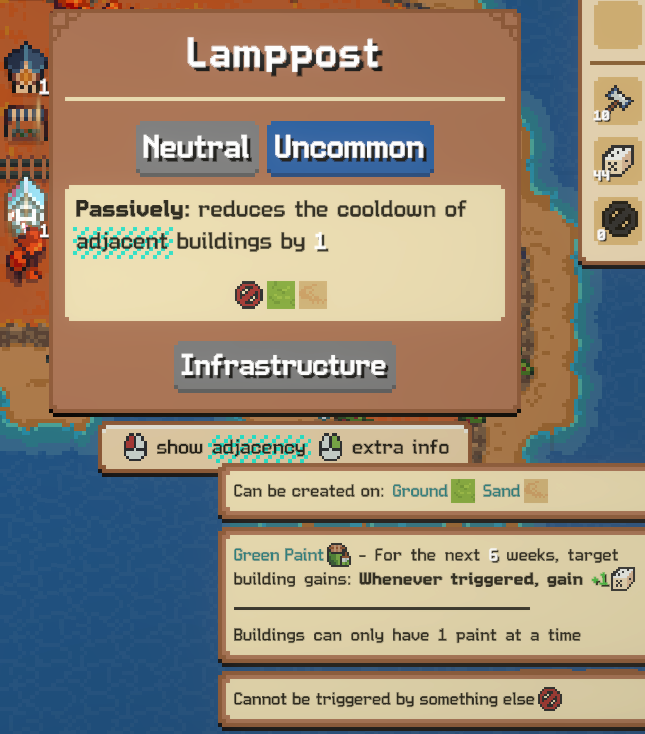
These two are confused constantly, and one popular guide even contradicts itself about the Lamppost. The pictured card settles the side we can document: this Lamppost passively reduces the cooldown of adjacent buildings by 1 — the adjacency it demands is between the Lamppost and the slowed building itself, not between that building and its own targets. The overview describes the Town Bell as the range answer, for buildings whose targets are legal but out of reach. If your chain fails because something fires too rarely, that is Lamppost territory — stand it next to the slow building; if it fails because the right tiles sit outside the shown area, that is Town Bell. Buying one for the other’s job changes nothing you can observe.
Plaza and Plateau: what they do and do not fix
The range-restriction thread’s accepted answer gives Plaza a precise job: it lifts the same-building range-overlap placement restriction — the rule that stops two copies of one building from covering each other. That is how players legally cluster multiples, with an Apiary cluster as the thread’s example. What Plaza does not do is relax creation rules: the same thread shows the misconception, and a Mine still demands adjacent Rocks, a Boat still demands water. Plateau answers a different shortage — legal ground: it adds a tile you can build on, but it does not supply Rocks or water and does not waive terrain requirements, so a card whose placement needs those still needs them.
Spend the turn only if it unblocks
- Verify the bottleneck survives one observation: watch a full cycle before buying. A chain that was merely waiting for its timer needs no neutral at all.
- Price the turn, not just the card: a neutral slot spent on the wrong row is a turn your scorer did not get — the thread’s players treat that as the real cost.
- Scaffolding is a target buff: it improves what a building already does; placed to fix a missing source, it is the classic wrong row.
- Walls are their own question: enclosures have supply and closure logic of their own — see the walls page before treating them as neutral filler.
When the real problem is that the needed building never appears at all, that is not a neutral question either — it is the draft-pool question.
The neutral roles come from emgeal’s Quick Overview (Sep 6, 2026 — whose Lamppost lines are internally inconsistent, resolved here in favour of the documented card), the Plaza answer from the range-restriction thread, and the Lamppost card from the paint guide, all read Oct 5, 2026. Exact values stay on live cards; no current-client test.